
Know your wear before it becomes downtime.
Real-time wear monitoring for critical liners and process equipment in extreme operating environments.
OPTIWEAR sensors turn liner wear into live, actionable information. Configurable sensor arrays support maintenance planning, replacement timing and wear-design decisions without waiting for an unplanned shutdown.

From sensor to decision
OPTIWEAR sensors turn liner wear into live, actionable information. Configurable sensor arrays support maintenance planning, replacement timing and wear-design decisions without waiting for an unplanned shutdown.
Non-conductive sensing
Designed for wet and slurry environments where conductivity can distort conventional readings.
Configurable arrays
Sensor layouts can monitor lifters, plates and other critical wear zones for the application.
Live reporting
Cloud-compatible reporting makes wear trends available to maintenance and operations teams.
Automated alerts
Threshold-based notifications help teams act before liner condition becomes an operational risk.
Published system capabilities
Where OPTIWEAR can be applied
A common monitoring concept adapted to different liner geometries, wear mechanisms and maintenance routines.
Mills
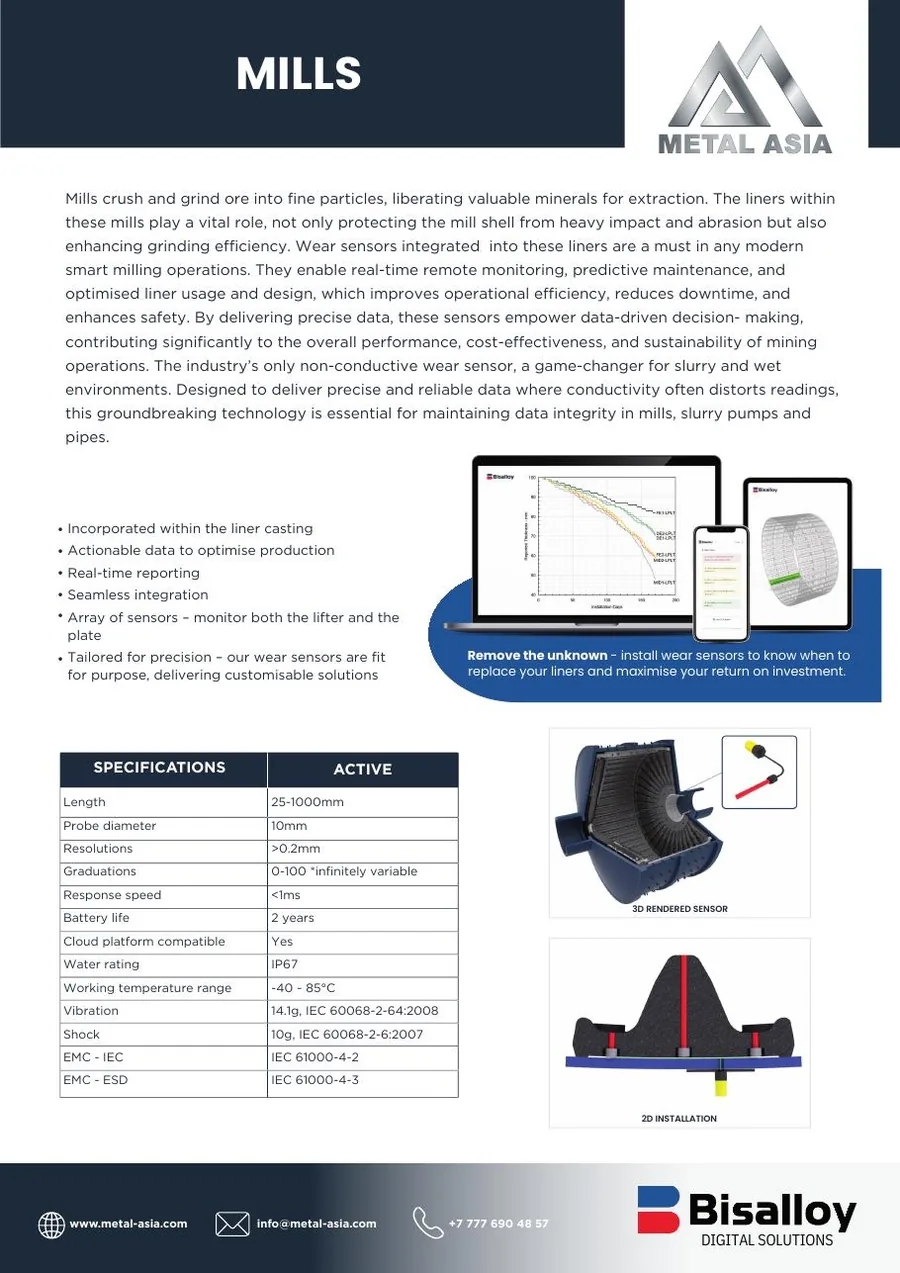
Sensors embedded in mill liners track wear at selected lifter and plate points while the mill operates.
Lifters · plates · liner designHaul trucks
Sensors installed in truck-body liners provide wear trends for replacement timing and predictive maintenance.
Tray liners · impact zones · change planningCrushers
Liner sensors monitor high-impact and abrasive zones inside the crusher chamber without interrupting operation.
Chamber liners · critical zones · uptimeChutes
Sensors follow wear in chute liners that protect the walls and support controlled material flow between process stages.
Flow path · impact points · liner lifeSlurry pumps
Non-conductive sensing in pump liners supports reliable wear data in wet, abrasive and high-density slurry service.
Pump liners · wet service · maintenanceHydrocyclones
Sensors embedded in internal liners help track abrasive wear that can affect classification and separation performance.
Internal liners · separation · efficiencySlurry pipes
Pipe-liner sensors monitor abrasive transport wear; pressure sensing can also be assessed for the application.
Pipe liners · wear trend · optional pressureOperational value
Real-time wear monitoring for critical liners and process equipment in extreme operating environments.
How the monitoring cycle works
Map the wear zones
The application, liner design and critical measurement points are reviewed before selecting the sensor arrangement.
Capture live wear data
Sensors report progressive wear through the selected measurement points and monitoring platform.
Plan the intervention
Trends and alerts support maintenance timing, stock planning and future liner-design decisions.
Six months of continuous liner insight
In a Western Australian gold-mine trial, a 12-sensor system monitored plate and lifter thickness for 171 days while the mill remained in operation. Results were checked against ultrasonic readings, 3D scans and physical inspections.
- 171-day trial
- 12-sensor system
- Daily plate and lifter measurements
- Cross-checked with independent inspection methods
Figures shown are published reference specifications. Sensor length, spacing, installation, battery arrangement and suitability must be confirmed for each application against the current official technical documentation.
Assess a monitoring point on your equipment
Share the equipment type, liner drawing, material, thickness and operating conditions. METAL ASIA can coordinate the initial technical review.